
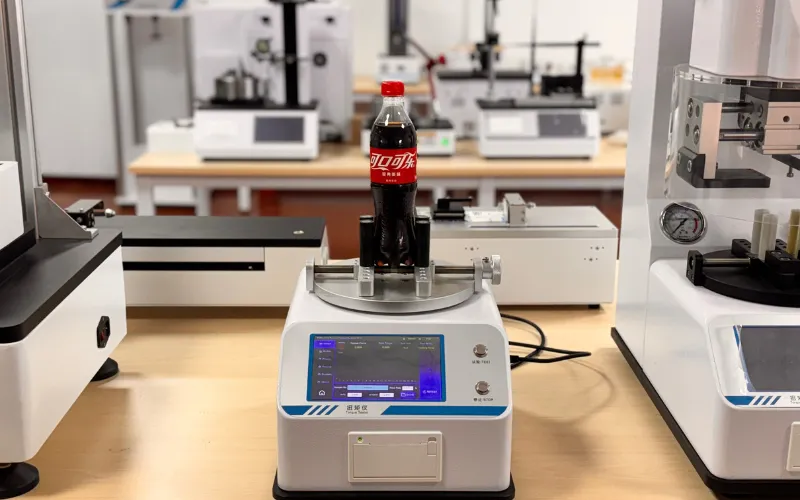
ISO 8317 Child-Resistant Closure Torque Testing: What the Standard Requires
ISO 8317 sets pass/fail outcomes for child-resistant packaging but does not specify torque values. Learn how torque testing fits into CRC compliance through ISO 13127 mechanical tests and production QC.
ISO 8317 is the international standard that defines performance requirements and testing procedures for reclosable child-resistant packaging. It does not specify a torque value. Instead, it specifies an outcome: children under a certain age must fail to open the package, while adults must succeed. That distinction matters because it shapes how torque testing fits into the compliance picture. The standard governs the design certification through panel testing, while a separate standard — ISO 13127 — provides the mechanical tests, including torque, that verify production consistency once the design is certified.
Below: what ISO 8317 requires, where torque measurement enters through ISO 13127, how the standard compares to the US regulation 16 CFR 1700, and what torque checks belong on the production floor. For a broader look at torque standards beyond child-resistant packaging, see the guide to torque testing standards including ASTM and ChP.
What ISO 8317 Covers and What It Does Not
ISO 8317:2015 applies to reclosable packages intended to be child-resistant — pharmaceuticals, household chemicals, e-liquids, pesticides. Push-down-to-turn caps, lug-finish closures, and snap caps all fall within its scope.
Compliance rests on a panel test, not an instrument test. Children attempt to open the package. Adults attempt to open and reclose it. Pass or fail depends on whether enough children are kept out and enough adults get in.
| Panel | Age Range | Sample Size | Time Allowed | Pass Criterion |
|---|---|---|---|---|
| Children (first attempt) | 42 to 51 months | Up to 200 (sequential) | 5 minutes | At least 85% unable to open |
| Children (after demonstration) | 42 to 51 months | Same group | Additional 5 minutes | At least 80% still unable to open |
| Adults | 50 to 70 years | 100 | Specified in standard | At least 90% able to open and reclose |
Sequential testing starts with a smaller group and expands only if results fall in a borderline zone. When the first group of children overwhelmingly fails or succeeds, the result is decisive without testing all 200.
No torque threshold. No force limit. No angular displacement requirement. ISO 8317 measures human performance against the closure, not the closure's mechanical properties in isolation.
Where Torque Enters the Picture Through ISO 13127
ISO 8317 answers one question: does this closure design keep children out while letting adults in? Panel testing is expensive, slow, and impractical for ongoing production verification. That is where ISO 13127 steps in.
Ten mechanical tests in ISO 13127 verify that a closure which already passed a panel test has not drifted out of specification after minor design or production changes. Several measure torque directly.
| ISO 13127 Mechanical Test | What It Measures | When Torque Is Involved |
|---|---|---|
| Torque release test | Torque needed to initiate cap rotation | Directly measures removal torque |
| Press-down-and-turn engagement test | Downward force required to engage a two-step cap | Measures engagement force; torque applied simultaneously |
| Push-and-turn test | Combined push force and rotational torque | Both torque and axial force recorded |
| Reverse ratchet torque test | Resistance to backward rotation | Torque in the reverse direction |
| Rotational torque test | Continuous torque through full rotation | Full torque profile |
| Non-squeeze torque test | Torque without lateral squeeze | Isolates rotational component |
One point is explicit in the standard: for two-step opening mechanisms such as push-down-to-turn caps, torque alone is not enough. Both torque and rotational angle must be captured simultaneously. A cap might release at low torque when the user applies the correct downward pressure, but resist high torque when the push-down step is not engaged. Peak torque alone on such a closure gives an incomplete picture.
What does that mean for equipment selection? A standard single-axis cap torque tester handles the torque release test and the rotational torque test. Push-down-to-turn closures require a tester capable of recording angle alongside torque, or a separate fixture that controls the axial load while torque is measured.
ISO 8317 vs 16 CFR 1700: Which Standard Applies to Your Market
A packaging engineer working across borders will encounter both ISO 8317 and 16 CFR 1700. They share the same goal — child-resistant packaging — but differ in protocol details.
| Parameter | ISO 8317:2015 | 16 CFR 1700.20 (US) |
|---|---|---|
| Governing body | ISO (international) | CPSC (United States) |
| Scope | Reclosable packages | Special packaging (reclosable and non-reclosable) |
| Child age range | 42 to 51 months | 42 to 51 months |
| Adult age range | 50 to 70 years | 50 to 70 years |
| Child sample size | Up to 200 (sequential) | 200 |
| Adult sample size | 100 | 100 |
| Child pass threshold | 85% fail in 5 min; 80% fail after demo | 85% fail in 5 min; 80% fail after demo |
| Mechanical supplement | ISO 13127 (10 tests) | No direct equivalent |
| Applies in | EU, UK, and most international markets | United States |
Age ranges and pass/fail thresholds are identical. Where the two diverge is what happens after certification. ISO 8317 pairs with ISO 13127 for mechanical verification of production changes. Under 16 CFR 1700, the US system relies on retesting through panels or engineering judgment, with no standardized mechanical test suite.
For companies selling into both markets, a closure that passes ISO 8317 panel testing will generally meet the 16 CFR 1700 child-resistance thresholds — but the regulatory filing and certification process differs. A US-market product needs CPSC protocol compliance regardless of ISO certification.
Production-Floor Torque Testing for Child-Resistant Closures
Panel testing certifies the design. Torque testing on the production floor verifies that every batch matches the design that was certified.
So what should a QC technician actually measure on a child-resistant closure? Three values matter:
Application torque — the torque the capping machine applies. This sets the baseline. If application torque drifts, removal behavior changes with it.
Removal torque — the peak torque recorded when opening the cap. For single-action screw caps, this is the primary QC metric. For two-step mechanisms, it must be paired with the engagement force or angle measurement described in ISO 13127.
Torque retention — the difference between application torque and removal torque after the package sits on the shelf. Liner compression, temperature cycling, and moisture absorption all reduce retained torque over time. A closure that passes at the capping station can fail in the field if retention drops below the threshold where adults struggle to open and reclose the package.
The failure that catches most production teams off guard is not children opening the package. It is adults failing to open it. ISO 8317 requires 90% of adults aged 50 to 70 to succeed. Over-torqued closures, especially on small-diameter pharmaceutical bottles, push that adult-accessibility number below 90% — and the package fails certification just as decisively as one that children open too easily.
Production torque check: what to verify
- Application torque matches the range specified for the panel-tested design
- Removal torque falls within the band that keeps both child resistance and adult accessibility
- For two-step closures: engagement force or angle is recorded alongside torque
- Readings are tagged to the specific mould cavity or capping head
- Recheck runs after every changeover in cap lot, bottle lot, or capping head setup
Common Failure Modes in Child-Resistant Closure Torque Testing
Different closure types produce different failure signatures on a torque tester. Recognizing the pattern points QC teams to the source.
Push-down-to-turn caps fail when the engagement mechanism wears or when moulding tolerances shift. The cap turns freely without the push-down step being engaged, giving a low and misleading torque reading. The torque number looks acceptable, but the child-resistant function has degraded because the two-step action no longer requires sufficient downward force.
Lug-finish closures fail at the other extreme. Excessive application torque locks the lug tabs so tightly that adults cannot generate enough grip force to release them. Torque readings during QC look high and stable — which appears reassuring until the adult panel test shows a failure rate above 10%.
Snap closures present a different challenge. Torque measurement in the traditional rotational sense does not apply. These closures rely on axial pull or pry force. Attempting to torque-test a snap closure with a standard rotational tester produces meaningless data. The QC check for snap closures requires a force gauge measuring pull-off or pry force, not a torque tester.
For any closure type, record each reading against the specific mould cavity or capping head that produced it. Aggregate averages hide single-cavity problems — one cavity out of a multi-cavity mould can produce closures that are consistently out of specification while the batch average looks normal.